Frequently asked questions
Customer service & ingredientsWe recently updated the packaging and artwork across our product range as part of an overall refresh. The new look and feel is designed to improve clarity, consistency, and ease of understanding across our products.
Although the packaging has changed slightly, the products themselves remain the same. There has been no change to the recipes or manufacturing processes.
During the transition period, you may see both the previous packaging and the updated packaging in stores or online, depending on existing stock.
We recently updated the nutritional information on our packaging based on the latest third-party laboratory testing.
Nutritional values, especially in food made from organic ingredients, can vary naturally, and updated testing helps us provide the most up-to-date information possible. We follow applicable US FDA and EU guidelines for nutrition labeling accuracy.
Please be assured that changes to the nutritional values do not mean the recipe has changed. The product remains the same; only the reported nutritional information has been updated.
As part of our packaging review, we updated the product name from Black Bean Spaghetti to Black Soybean Spaghetti.
This change was made to better reflect the product’s main ingredient: black soybeans. The updated name provides clearer alignment between the product title and the ingredient declaration, and supports clearer food labeling, particularly for consumers managing soy allergies.
The change is purely related to the product name. The recipe, ingredients, and manufacturing process remain unchanged.
Our NEW Edamame & Mung Bean Rigatoni is currently launching in the US and is a great addition to our pasta line-up! It is our first ever short cut made with the main ingredient edamame. While it is part of our plant-based pasta range, it is a new product with its own unique recipe and nutritional profile.
Unlike our other edamame and mung bean pastas, this product is manufactured in Thailand and includes brown rice in the recipe. The brown rice helps create a finer taste and texture, while still offering strong plant-based nutrition. And although the values are different from our original Edamame & Mung Bean Fettuccine, the Rigatoni still provides an impressive nutritional profile, especially compared with traditional pasta. It remains a high-protein, high-fiber, plant-based option made with simple ingredients.
Please note that this is a not a replacement for our existing Edamame & Mung Bean Fettuccine.
Our consumers are our top priority. All our products continue to meet USDA/EUOrganic certification standards which require strict oversight of ingredients, farming practices and processing methods. This certification also means our supply chain is subject to ongoing 3rd party inspections and audits and testing based on regulations for NON GMO, Gluten, pesticides, physical, microbiological and chemical tests. We are also required based on US FDA and EU regulations to conduct nutritional testing and update labels.
We recently updated the Nutrition Facts on our packaging based on the latest laboratory testing of our products to make sure the information you see is as accurate and reliable as possible.
We know that changes to nutritional numbers can raise questions, however please know:
- Nothing has changed in our recipe – only the way we report the nutritional information has.
- We test our products in 3rd party recognized labs and follow all US FDA/EU guidelines for accuracy.
- US/EU regulations allow for natural variation in foods, but we work to keep our values with the most accurate information possible.
Our goal is to be as transparent as possible, meeting the highest standards for organic certification, food safety and label accuracy so you can have full confidence in our products. We hope that this explains the current differences. The transition period will depend on the stock in-store and could vary, so we appreciate your patience.
We look forward to continuing to provide you with products you can enjoy.
Proposition 65 (California Safe Drinking and Toxic Enforcement Act of 1986)
As you may already know, Prop 65 is a California law which operates independently from FDA regulations. Prop 65 aims to protect California’s public health from chemicals known to cause cancer, birth defects or other reproductive harm and includes some 900 different chemicals. It covers a wide range of products including consumer goods, food and environmental exposures. Prop 65 is seen as stringent as it requires businesses to inform consumers about the presence of potentially harmful chemicals, even at very low exposures and requires warnings to the labelling.
As a company, Explore Cuisine follow the guidance of FDA regulations. Our customers are our top priority and we take every precaution to make sure that our products are made with the highest quality ingredients & packaging and that the manufacturing processes at the factories are followed based on organic certification as well as having regular audits for global standard food safety, manufacturing processes and labour standards. For this reason we test for mycotoxins, heavy metals, microbiological profiles and pesticides. As we use organic plant-based raw materials, crops can be particularly sensitive to environmental effects – we therefore have a higher risk to some of these contaminants which are naturally present in water, air, and soil and can differ from batch to batch. A recent test found low levels of lead which were way below FDA regulations but not Prop 65.
When providing our pasta brand to known businesses in the state of California we must comply with Prop 65 regardless of FDA compliances to avoid legal repercussions and potential lawsuits. The stringent requirements and independent enforcement create a situation where businesses must comply with Prop 65 to operate in California and to label appropriately.
Under the guidance of an expert, we have decided to include the warning to our packaging destined to California.
FDA lead tolerances: <0.2 mg/kg
Prop 65 tolerances: Maximum Allowable Dose Level 0.5 micrograms / day
Explore Cuisine products are sold in over 25 countries! Head to the page of the product you are looking for to find a store near you.
When our Founder, Joe, was developing the brand, he searched the globe to find the best places to source our raw materials and manufacture our products. Our chickpea and lentil pastas are made in Italy and Thailand. And our bean pastas are made in China. At Explore Cuisine, we want to make sure your expectations of high quality are met. That’s why all our factories are certified organic and dedicated gluten-free facilities.
All of our ingredients are certified organic, Non-GMO and are sourced from farms near the factories that make our delicious pasta. Made from the goodness of beans, chickpeas, lentils, rice and peas, our ingredients are the heros. All of our pastas are plant-based with no additives.
Soybeans (Glycine max) are a species of legume native to East Asia. They are a great source of protein. Per acre, soybeans produce more protein than most animal-based proteins do, meaning that they’re good for the planet. At Explore Cuisine, we use several types of organic soybeans to give the finest texture to our great-tasting bean pastas.
There are mainly two types of black beans: One type of black bean is used in Asian cuisine, and another is used in Latin American cuisine. The black beans we use in our products like our Black Bean Spaghetti, are part of the soybean legume family, which is native to East Asia. They are known for their high-protein, high-fiber, low-carbohydrate nutritional value. The black bean popular in Latin American cuisine is also called the black turtle bean. The black turtle bean has a dense, meaty texture, which makes it popular in vegetarian dishes, such as Frijoles Negros and the Mexican-American black bean burrito. The black turtle bean has half the protein and double the carbohydrate of the black soybean, and so while it is a wonderful bean, it’s not commonly used to make noodles or pasta.
China is one of the largest soy-based bean (yellow, black and edamame) producers on a global basis. They’re recognized for the high standards of organic and non-GMO beans, which have been celebrated in Asian cuisine for centuries. At Explore, we believe in going to the original source to discover products of the highest quality.
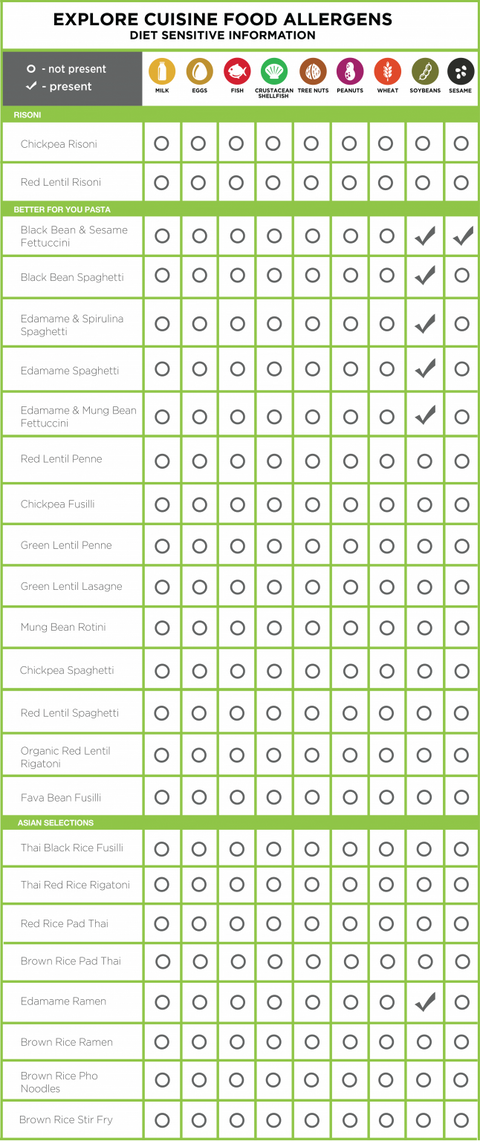
All of our factories and products are gluten-, tree nut- and dairy-free. Sesame seeds are present in our Black Bean & Sesame Fettuccine product. All Black Bean & Edamame products contain soy. Safety measures and between-production cleaning take place to leave no trace of any cross-contamination. Please advise our allergen chart below for full details.
The packaging from our Edamame and Black Bean products are 100% recyclable, even the plastic bag. For all other packing, the cardboard box can be recycled, but the plastic bags and plastic window must be disposed of separately. We are working hard to make all our packaging 100% recyclable without jeopardizing the integrity or quality of our products. Stay tuned!
The nutrition information is based on dry, uncooked product.
The serving size is the amount of pasta recommended for one person. This amount varies from country to country, following country-specific regulations. Please read the label on your country’s box for specifics.
Frequently Asked Questions
CookingWe value efficient cooking, and so our pastas all cook within 12 minutes. Each pasta has its own specific instructions on the box, and we encourage you to follow them for the best possible pasta! All Explore Cuisine pastas can be kept warm in the pan, reheated, or served cold.
We recommend you store your leftover pasta in the refrigerator under normal temperature for up to 2 days.
No, you don’t need to boil our lasagne noodles before layering them in a dish. Just make sure to put plenty of sauce on both sides of the pasta, including at the bottom of your dish and on the top layer of your lasagne (before vegan cheese!).
All Explore Cuisine products are gluten-free and made from legume-based ingredients. It’s normal that they’ll cook differently than wheat-based pasta. To reduce the foam, simply add more water to the pot and a splash of olive oil and / or salt.
Chickpea Fusilli
Our Chickpea Fusilli has a new formula.At Explore Cuisine we make plant-based nutrition simple. Because when we make great nutrition easy for everyone, we’re enabling those consistent, little changes that make a big impact. The decision to change our Chickpea Fusilli product was not made lightly. However, we are now able to deliver a cleaner, more sustainable product with fewer ingredients and a faster cooking time.
We have moved production of our Chickpea Fusilli product from production in Italy to our factory in Thailand. Importantly, our Chickpea Fusilli made in Italy typically had a cooking time of 9-11 minutes, while our Chickpea Fusilli made in Thailand has a reduced cooking time of 4-6 minutes, making our Chickpea Fusilli even easier to prepare.
The Chickpea Fusilli made in Italy originally contained four ingredients, while our new versioncontains only two ingredients – Organic Chickpea Flour and Organic Brown Rice, flour for better taste and texture. Brown rice is cultivated locally in North East Thailand by farmers in partnership with our Food to Thrive Foundation. For more information on this, please visit:https://explorecuisine.com/pages/food-to-thrive
Our simpler product formulation contains more fiber per serving –10g per 3.5oz serving vs 6g in the previous formula. This new formula contains 20g protein per 3.5oz serving. While there is a slight reduction in protein content, it still offers a significant source of plant-based protein.
Explore Cuisine has transitioned from a box with a window to recyclable bag-in-box packaging for their Chickpea Fusilli product. This change is environmentally friendly and helps reduce waste.Because the product is coming from Thailand, it now is required to have a plastic bag to protect the integrity of the pasta as per regulations.
Our Certifications
Organic Certifying Bodies follow strict policies and procedures on how the product is produced, processed, transported and stored. Our factories are USDA- and EU-certified.
The Non-GMO Project is committed to preserving, building and educating consumers while supporting organic agriculture. Find our registered products here.
All of our products are naturally gluten-free and are either certified by the Gluten Intolerance Group (GIG) or with the Cross Grain symbol from the Association of European Celiac Societies (AOECS).